 Our use of cookies
 Business water bills: Breakdown, examples and explanation of each section
Business water bills can be confusing; they are packed with acronyms and terms only used in the British water industry. If you’ve ever wondered what you’re actually paying for, you’re not alone.
Our experts have prepared this guide, which breaks down every key section of a business water bill with clear explanations and real examples, so you can check your charges, spot errors, and stay in control of your costs. Here’s what we cover:
- Breakdown of a typical business water bill
- How water charges work on a business water bill
- How wastewater charges work on a business water bill
- How to set up your first business water bill
Breakdown of a typical business water bill
Below, we explain the five key sections of a business water bill.
Your supply details
A business water bill will include the following details to clarify exactly which property, connection, and meter are being charged for water usage:
- Account number – A unique identifier used by business water suppliers to identify your company.
- SPID – The SPID (Supply Point ID) is a unique identifier used by the market operator MOSL to identify a specific non-domestic water connection.
- SPID address – The address of the property that is supplied by your business water connection.
- Meter serial number – A unique identifier associated with the business water meter installed at your business water connection.
- Meter size – The diameter of the incoming communication water pipe to your business, measured in mm.
Billing summary and amount due
The summary of charges section defines the billing period over which your business water rates are calculated and states:
- Total water and wastewater charges due – A detailed calculation is provided later in the bill.
- Balance due – The total amount payable, calculated as the water charges for the billing period plus any unpaid balances.
- Payment information – Instructions on how to pay the bill, or the date on which payment will be automatically collected via Direct Debit.
Meter reading and water consumption calculation
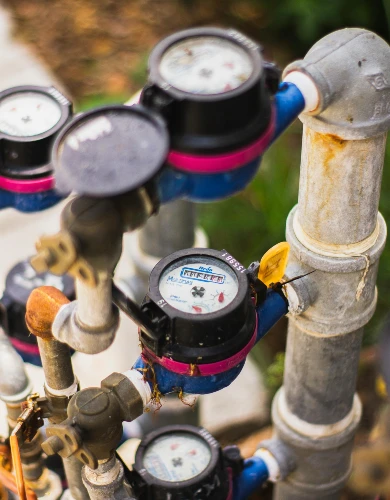
Most commercial properties in Britain have a water meter installed to measure the consumption of water.
A business water bill displays meter readings taken during the billing period to calculate water consumption in cubic metres. Here is an example:
Billing period: 01/04/2025 to 30/09/2025
| Type of reading | Date | Reading | Consumption (m³) | Notes |
|---|---|---|---|---|
| Opening estimated meter reading | 01/04/2025 | 00908 | - | This is the final meter reading used on the previous bill. |
| Actual meter reading | 15/07/2025 | 01540 | 632 | Meter reading taken by your supplier or manually submitted by your business. |
| Closing estimated meter reading | 30/09/2025 | 01800 | 260 | Estimated by your supplier based on previous consumption rates. |
| Total water consumption during billing period | 892 |
Calculation of wastewater disposal
Business water rates include a charge for each cubic metre of water disposed of into the sewers.
As most commercial properties do not have a dedicated wastewater meter, a business water bill will typically use the following estimation:
Most water companies apply a standard return to sewer allowance of 95%.
💡 If your company uses water in a way that does not return it to the sewers, such as growing plants or manufacturing products, you may be able to claim a sewerage rebate for your business.
Your charges
Business water bills contain a detailed breakdown of each element of your charges during the billing period. This brings together the costs for water, sewerage, and drainage services.
The sections below explain how each charge is calculated.
How water charges work on a business water bill
Water charges on a business water bill relate to the supply of fresh, potable water to your business premises. The water charge depends on how much water your business uses.
The example below shows a typical water charges section of a business water bill.
| Charge type | Units | Rate (£) | Charge (£) |
|---|---|---|---|
| Fixed water charge | 180 days | 0.25 | £45.00 |
| Volumetric water charge | 892 | 2.32 | £2,069.44 |
| Total water charges | £2,114.44 |
The fixed standing charge covers the cost of maintaining your connection to local water infrastructure.
The volumetric charge is a fee for each cubic metre of water consumed by your business. The charge per cubic metre of water depends on the location of your premises and the scheme of charges set by your business water supplier.
How wastewater charges work on a business water bill
This section explains how wastewater and other drainage charges appear on, and are calculated on, a business water bill.
Wastewater charges
These charges cover the removal of used water from your business premises into the sewers. They apply to any premises that have a connection to the sewer system.
The example below shows a typical wastewater charges section of a business water bill.
| Charge type | Units | RSA (%) | Rate (£) | Charge (£) |
|---|---|---|---|---|
| Fixed wastewater charge | 180 days | – | 0.60 | £108.00 |
| Volumetric wastewater charge | 892 | 95% | 2.82 | £2,389.67 |
| Total wastewater charges | £2,497.67 |
The fixed wastewater charge is applied by the supplier to cover the cost of maintaining the pipes that connect your property to the local sewers.
💡 Businesses that dispose of trade effluent into the sewers will have an additional line for trade effluent charges.
Drainage charges
In around half of English regions, businesses are charged separately for surface and highway drainage. Drainage charges are fixed annually and depend on the size of the property.
The example below shows a typical surface drainage charges section of a business water bill.
| Charge type | Units | Rate (£) | Charge (£) |
|---|---|---|---|
| Surface water drainage | 180 days | 0.72 | £129.60 |
| Highway drainage | 180 days | 0.97 | £174.60 |
| Total drainage charges | £304.20 |
The daily charges for surface and highway drainage are determined by the size of your commercial property. For more information, visit our surface drainage charge guide.
Total charges
The total charges due for the billing period are the sum of the water, wastewater, and drainage charges:
| Charge type | Charge (£) |
|---|---|
| Water charges | £2,114.44 |
| Wastewater charges | £2,497.67 |
| Drainage charges | £304.20 |
| Sub total | £4,916.31 |
| VAT | – |
| Total charges in period | £4,916.31 |
Most businesses do not pay VAT on business water bills.
How to set up your first business water bill
In the first few months after moving into a new commercial property, the current water supplier for the property will typically send a water bill by post.
Your first bill will request details of the business now occupying the property if the supplier has not already received this information from the previous tenant. They will usually provide a form on their website for submitting these details.
For more information, visit our guide to dealing with your water supply when moving business premises.
Your first water bill will usually be charged based on default business water tariff rates, which are often more expensive and are published by each water supplier on their website.
At AquaSwitch, we offer a free, no-obligation business water comparison service to help companies on default tariffs save thousands by switching business water suppliers.
 Back to blog
- Share: