 Our use of cookies
 Business water interruption: What to do if your water supply stops
Losing your mains water can bring a business to a standstill, yet most owners give it little thought until the taps run dry.
Interruptions are rare in the UK, but when one happens, commercial properties are treated differently from domestic properties. Households are prioritised for help, while businesses are largely left to cope on their own.
Our guide covers all you need to know if your business water supply is interrupted.
What is a business water interruption?
A business water interruption is any loss or reduction of the mains water supply to your commercial property. The main types are:
- Planned: The local water company schedules maintenance, repairs or upgrades and gives you advance notice.
- Unplanned: The supply fails without warning, usually due to a burst main, equipment failure, or contamination.
- Emergency: The supply is cut at short notice to protect public health or safety.
- Partial: Water still reaches you but falls below normal standards, often showing as low pressure, a trickle from the taps or discoloured water.
What should you do if your business has no water?
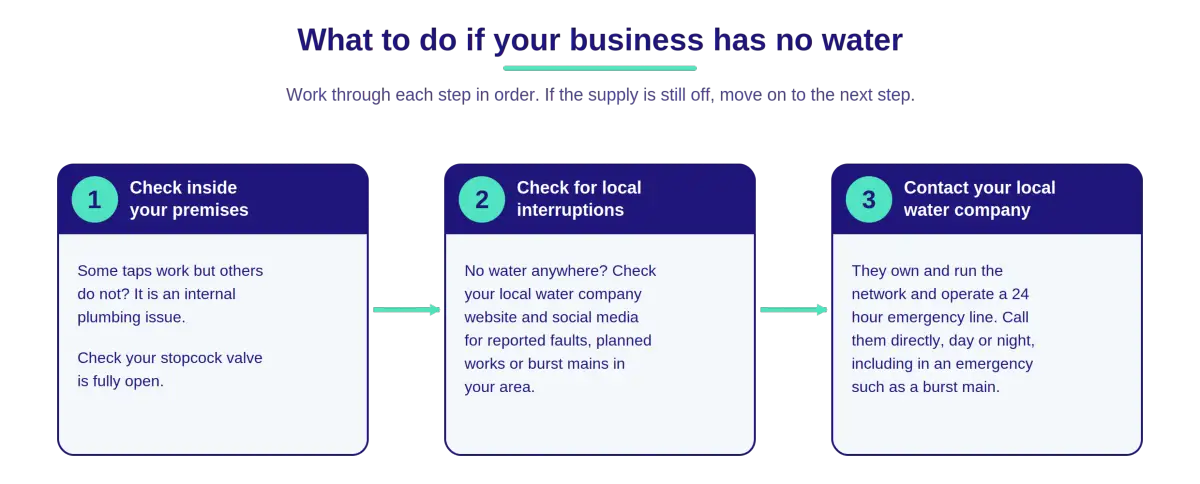
If the water stops at your business premises, we recommend working through these steps in order.
Most business water interruptions are quick to diagnose, and a few minutes of checking can tell you whether the fault is yours to fix or one for the water company.
1. Check whether the issue is inside your premises
When you notice a problem with the water supply, we first recommend analysing whether the problem is with the pipes or water fittings at your property, rather than a wider water network issue.
If some taps are working but others are not, the supply is reaching your property, and you are likely dealing with an internal plumbing or water leak issue rather than an interruption.
Next, find your stopcock valve, the point where your property connects to the mains, and check it is fully open. A partly or fully closed stopcock will reduce or cut off water to the whole building. If you are not sure where yours is, our water pipes diagram shows the typical layout and who is responsible for each section.
2. Check for local water supply interruptions
If the whole property has lost water, the cause is likely to be in the nearby network. Check your water company’s website and social media channels for reported faults, planned works or burst mains in your area.
Local water companies usually post live updates, often with a postcode checker and an estimated time for the supply to return, before they contact customers individually. This is the fastest way to confirm whether the problem is known and being worked on.
3. Contact your local water company
Your local water company owns and operates the pipes in your region and must maintain a 24-hour emergency line. Call them directly to report a loss of supply or an emergency, such as a suspected burst main or flooding.
They can confirm a known fault, give a timescale and arrange the repair. If you are not sure who covers your area, use the Water UK tool to find your local water company.
Who is responsible during a business water interruption?
Responsibility for an interruption depends on where the fault lies and who controls that part of the supply.
Knowing which party is accountable helps you direct your call to the right place and understand what to expect from each.
Local water company responsibilities
The local water company owns and maintains the public network in your region, including the mains and the pipes up to the boundary of your property. It is responsible for the physical supply, which means:
- Fixing burst mains and other faults on the network
- Restoring service after an interruption
- Maintaining water pressure and water quality
- Providing alternative supplies where required
In an unplanned interruption, the local water company is usually both the party at fault and the one carrying out the repair.
Business water supplier responsibilities
Your business water supplier is the company you buy water from, and that issues your business water bills. They do not own or operate the network, so their role in an interruption is limited. In practice, they are responsible for:
- Your account and billing, not the physical supply
- Handling any compensation due under the guaranteed standards after the event
They cannot fix the pipes, restore the supply or tell you what is happening on the network, so they are not who you first contact when experiencing an interrupted water supply. For that, go straight to your local water company.
Responsibilities of the owner/occupier
Everything on your side of the boundary stopcock is private, which means neither the local water company nor your supplier will repair it. This covers the supply pipe into the building, the internal plumbing, taps, tanks and any private storage.
Who fixes it depends on your lease. If you own the premises, it falls to you. If you lease them, responsibility usually lies with the landlord, including shared pipework and communal areas.
Planned and unplanned water interruptions
Water interruptions fall into two categories, depending on whether the water company anticipated the event. The distinction matters because it affects the notice you receive and the compensation you can claim.
Planned water interruptions
A planned interruption is one that the local water company schedules in advance, usually to carry out maintenance, repairs or upgrades to the network, such as replacing a section of main or connecting new infrastructure.
Because the work is known about ahead of time, you should be told before your supply is affected.
Under the guaranteed standards, each water company is expected to give notice of at least 48 hours before a planned interruption. That notice should tell you when the supply will go off, how long it is likely to last and when it should return, giving you time to plan and adjust operations for the interruption.
Unplanned water interruptions
An unplanned interruption happens without warning because the local water company could not foresee it. These are typically caused by burst mains, infrastructure failures, equipment faults or contamination events that force the supply to be shut off at short notice to protect public health.
With no chance to prepare, unplanned interruptions tend to be the most disruptive for businesses. They are also the category most likely to qualify for compensation, since the water company is usually at fault.
Alternative water supplies during an interruption
During a prolonged mains water interruption, the local water company has a duty to provide an alternative source of water to impacted households. However, businesses are not covered by this protection.
This section explains what happens with alternative water supplies and what businesses should expect.
What the law requires
Under the Security and Emergency Measures Direction, made under the Water Industry Act 1991, if the piped supply fails, the water company must provide at least 10 litres of water per person per day within the first 24 hours, and every 24 hours after that until the piped supply is restored.
After five days, that minimum rises to 20 litres per person per day. The regulator, Ofwat, confirms the same baseline and that the supply must be kept up until normal service returns.
How alternative water is delivered
Water companies meet this duty in a few ways. They may hand out bottled water or supply it through bowsers and standpipes positioned in the affected area.
Bottled water is usually offered at collection points or, in some cases, delivered to the door. Customers on the Priority Services Register have alternative supplies arranged for them by their water company, and sensitive sites such as hospitals and care homes are prioritised, often by tanker.
Are the rules the same for businesses?
No. The statutory volumes cover people’s basic drinking, cooking and hygiene needs, so households and sensitive sites are prioritised first.
An ordinary business has no guaranteed right to an alternative supply and will only be helped on a case-by-case basis if resources allow.
The local water company is not obliged to supply a business, so the responsibility sits with you. Your practical options are:
- Follow your business water contingency plan if you have one prepared, so you are acting on decisions already made rather than working them out mid-interruption.
- Use bottled water where your needs are small enough to be covered that way.
- Arrange an emergency water supply by tanker or bowser through a water contingency specialist, where continued operation is essential.
- Temporarily close if you cannot operate safely or usefully without water.
Business water interruption compensation
If a water company falls short of the guaranteed minimum standards, you may be owed a fixed payment. These are modest amounts, though, and are not designed to cover what an interruption actually costs a business.
The guaranteed standards scheme
Every customer, businesses included, is covered by a set of guaranteed minimum standards laid down by the Government. If a water company misses one of them, it owes you a fixed payment, usually paid without you having to ask.
Where it is not paid automatically, you can claim within three months of the incident. The payments for business customers in England and Wales are:
| What goes wrong | Payment to a business |
|---|---|
| Incorrect notice of a planned interruption | £100 |
| Supply not restored, initial period | £100 |
| Supply not restored, every 12 hours | £100, capped at twice your annual water charges |
| Low water pressure, per incident (up to 5 a year) | £50 |
Source: Ofwat guaranteed standards scheme
As an example, the supply not restored payment works out at around £100 for every 12 hours the water is off, but it is capped at twice your annual water charges. Even at the cap, the total will not come close to covering a week of lost trade.
On top of this, there are important exceptions. Your business cannot claim compensation for a water supply interruption caused by:
- Industrial action
- Severe weather
- Exceptional circumstances
- Droughts
The guaranteed standards are only designed to apply when your water company is at fault. To make a claim, contact your business water supplier, who is responsible for paying the guarantee.
What is not covered
The payments are fixed and small, and will not cover lost revenue, spoiled stock or any other knock-on loss to the business.
No payment is due at all where severe weather or other exceptional circumstances outside the company’s control caused the interruption. The guaranteed standards only cover you when the water company is genuinely at fault.
Business water interruption insurance claims
Losing the mains supply can quickly hit a business financially through lost sales, and a business interruption policy is what you would use to recover that lost income.
This type of insurance protects against financial loss from events such as fires and floods, but whether it covers a loss of mains water depends on the precise wording of your policy and what caused the interruption. Check whether yours extends to loss of the mains supply, and add it if it does not.
How to prepare your business for a water supply interruption
The single most useful thing you can do is put a business water contingency plan in place before you ever need one.
Since you cannot count on the local water company to keep you running, a plan made in advance means you act on decisions already taken rather than working them out in the middle of an incident. It does not need to be elaborate, but at a minimum, it should cover the following:
- Your critical water-dependent activities. Map which parts of your operation cannot run without water, such as food preparation, cleaning, cooling or toilets, so the plan makes clear what stops and what can carry on.
- How will you source emergency water? Decide whether you will hold a reserve of stored or bottled water for short interruptions, and how you would arrange a tanker or bowser through a water contingency specialist if a longer interruption threatens operations.
- Alternative cleaning and hygiene arrangements. Build in a fallback for handwashing, toilets and cleaning, whether that is hand sanitiser, wipes or an arrangement to use nearby facilities, so you stay within health and hygiene rules.
- When and how you close. Set the point at which you stop trading and the steps to wind down safely, along with who is responsible for making that call.
- Your key contacts. Keep your business water supplier’s number, your SPID and the local water company’s emergency line in the plan where everyone can find them, and check they stay current.
Business water interruption – FAQs
Below, our experts answer the most commonly asked questions regarding business water interruptions.
Can a business request advance warning of planned water interruptions in a specific area?
Yes. For planned work that interrupts your supply, the local water company must notify affected customers in advance, at least 48 hours beforehand in England, or 24 hours in Wales, usually by a card through the door.
You can also sign up for your water company’s alerts for your area and check its website for scheduled works, and customers on the Priority Services Register can ask to be told directly.
Does low water pressure qualify for compensation under the guaranteed standards scheme?
Yes, within limits. If the pressure in your communication pipe falls below the minimum of seven metres static head on two occasions, each lasting more than an hour, within a 28-day period, a payment is automatically due.
The statutory amount is £50, though some water companies voluntarily pay more. It does not apply where the drop is caused by necessary works or by drought.
Find out more in our full business guide to low water pressure.
Can businesses claim compensation if a water interruption damages equipment?
Not through the guaranteed standards. Those payments are fixed sums for missed service standards and do not cover knock-on losses such as damaged equipment.
Receiving a guaranteed standards payment does not mean the company has accepted legal responsibility for any loss or damage, and the scheme does not affect your other legal rights, so equipment damage would typically be pursued through a business interruption insurance policy.
Are businesses with multiple sites compensated separately for each affected premises?
Generally yes.
Guaranteed standards payments are made per affected supply, so each site that meets the standard is treated as its own claim. A business with several premises hit by the same incident should receive a payment for each qualifying site, subject to the usual conditions.
Can businesses receive compensation if alternative water supplies are unsuitable for their operations?
Not under the guaranteed standards.
The duty to provide an alternative supply is about drinking water for people, not water of a volume or quality suited to a commercial process, so bottled water or a bowser being impractical for your operation does not trigger a payment.
Recovering the resulting trading losses comes back to your business interruption insurance, where the cause is covered.
 Back to blog
- Share: