 Our use of cookies
 Commercial greywater systems: Treatment, recycling and reuse
Greywater systems give businesses a practical way to cut mains water use by capturing lightly used wastewater, treating it on site, and putting it back to work for non-potable applications like toilet flushing, irrigation and cooling.
With UK water scarcity rising and the water footprint of commercial buildings under growing scrutiny, on-site recycling is becoming a popular option.
This guide walks through how the systems work, where they fit best, and what to consider before installing one.
What is a greywater system?
Greywater is lightly used wastewater from sinks, showers, baths, basins and washing machines. It carries small amounts of soap, hair, skin cells, lint and food residue, but not the heavier contamination found in toilet waste or kitchen sink water with significant food debris.
That heavier wastewater is called blackwater, and the two are kept separate because blackwater needs full sewage treatment before it can be reused or discharged.
A greywater system captures this lightly contaminated wastewater on site, filters and treats it to a safe standard, and redirects it for reuse in applications that do not require drinking water quality.
Treated greywater is non-potable, meaning it is not safe for drinking, cooking or personal washing, but it is well-suited as a sustainable water supply for toilet and urinal flushing, irrigation, vehicle washing, and general outdoor cleaning.
Types of greywater processing
There are three terms used to describe separate functions in a greywater system:
- Greywater harvesting is the collection and storage of greywater from its source, usually through a separate drainage pipework that diverts wastewater away from the main sewer before it mixes with blackwater.
- Greywater treatment is the process of cleaning the harvested water through filtration, biological treatment or disinfection so that it reaches a standard suitable for its intended reuse.
- Greywater recycling describes the full cycle of harvesting, treating and reusing the water on site, and is the term most commonly used for the complete system installed in a commercial property.
How does a greywater system work?
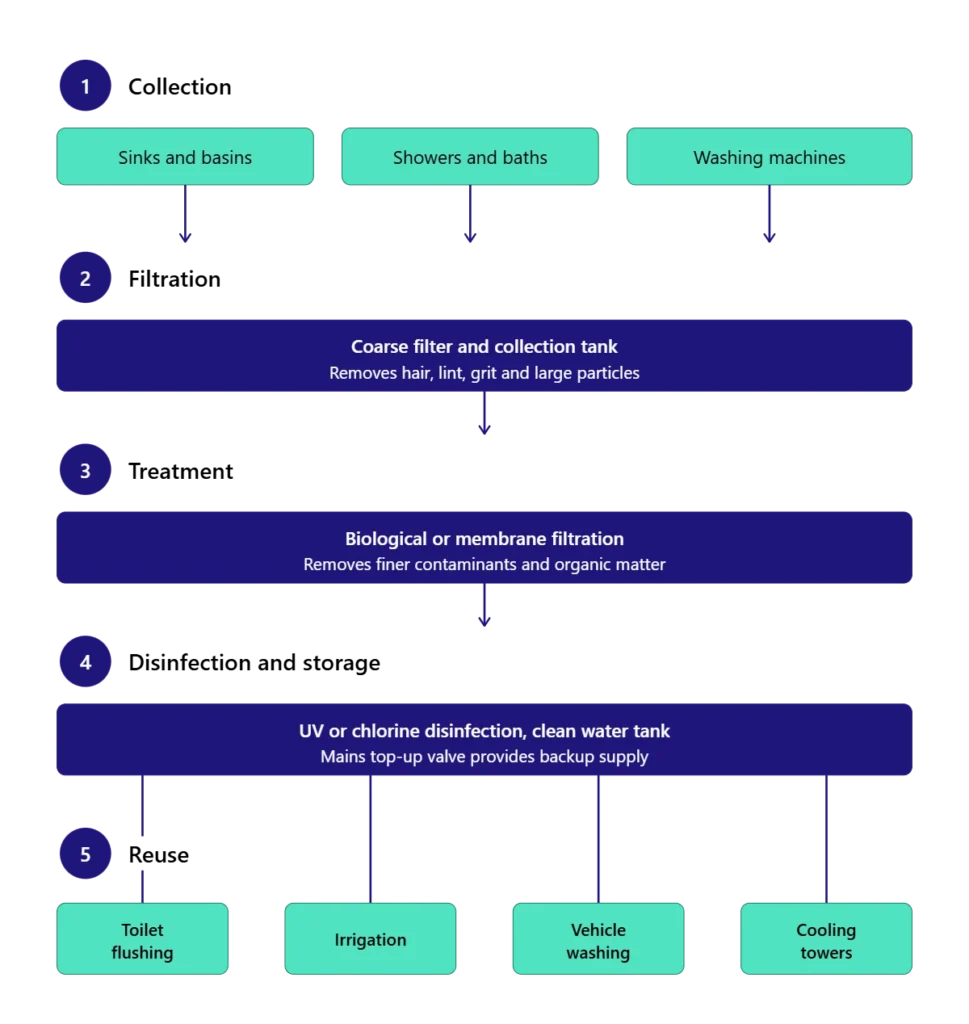
A commercial greywater system works in five clear steps, taking lightly used wastewater and turning it into a safe, non-potable supply for reuse around the building.
Step 1: Collection
Greywater is separated from blackwater at source through dedicated drainage pipework.
Wastewater from showers, basins, sinks and washing machines is diverted into a holding tank, while toilet and kitchen waste continues to the main sewer.
Step 2: Filtration
Coarse filters at the tank inlet remove hair, lint, grit and other large particles. This protects the treatment equipment downstream and prevents blockages in the system.
Step 3: Treatment
The filtered water passes through a treatment stage that may use biological filtration, membrane filtration or a combination of both. This stage removes finer contaminants and organic matter so the water meets the required standard for reuse.
Step 4: Disinfection and storage
Treated water is disinfected, usually with UV light or chlorine dosing, to prevent bacterial growth. It is then held in a clean water tank ready for use, with a mains top-up valve providing backup if reuse demand exceeds supply.
Step 5: Reuse
Treated greywater is pumped on demand to non-potable outlets across the building.
Larger commercial installations are typically monitored remotely, with sensors tracking flow rates, water quality and tank levels to flag any issues before they affect supply.
If your business is also looking at water capture from external sources, commercial rainwater harvesting systems can run alongside greywater recycling to further reduce mains water demand.
What can treated greywater be used for?
Treated greywater is non-potable, meaning it has not been treated to drinking water standards.
It is not suitable for drinking, cooking, food preparation, handwashing, showering, swimming pools, or any application involving direct human contact, but it is well suited to a range of commercial applications where drinking water quality is not required.
Common reuse applications include:
- Toilet flushing
- Urinal flushing
- Landscape and garden irrigation
- Vehicle and fleet washing
- Cooling tower top-up
- General outdoor cleaning
The exact list of permitted uses depends on:
- Treatment quality. Basic filtration may only support sub-surface irrigation, while full biological treatment with UV disinfection can supply indoor uses such as toilet flushing.
- System design. Indoor reuse requires separate pipework and clearly marked non-potable outlets to prevent cross-contamination with the mains supply.
Greywater systems standards
Greywater systems in the UK must meet a clear set of standards covering installation, operation and water quality. The current framework is:
- BS EN 16941-2:2021 is the primary standard for on-site non-potable water systems using treated greywater, covering design, installation, commissioning and water quality.
- BS 8525-2:2011 remains current for domestic greywater treatment equipment.
- The Water Supply (Water Fittings) Regulations require strict separation between mains water and non-potable systems, with backflow prevention where they interact.
Pipework carrying treated greywater must be clearly marked and outlets signed as non-potable to prevent accidental use. Your local water company must also be notified before installation.
Sources: BS EN 16941-2:2021, BS 8525-2:2011, Water Supply (Water Fittings) Regulations 1999
What are the benefits of using a greywater system as a business?
Greywater recycling delivers measurable returns for commercial properties that use significant volumes of water. The benefits fall into three main areas:
| Benefit | What it means for your business |
|---|---|
| Lower water bills | Reduced mains water consumption directly lowers business water rates and sewerage costs, and supports wider efforts to reduce water consumption across the building. |
| Resilience against water scarcity | The Environment Agency has projected a shortfall of around five billion litres of water per day in England within the next 25 years. Recycling reduces exposure to future price increases and supply restrictions. |
| Lower carbon footprint | Less treated mains water consumed means lower embedded carbon from water treatment and distribution, helping to reduce the wider environmental impact of the water industry. |
Greywater systems work best alongside good day-to-day management of your water costs.
Even with a commercial greywater system, it’s important to ensure you have a competitive business water supplier tariff. Use our free business water comparison service to find out how much you can save from switching business water suppliers.
How much does a greywater system cost?
Commercial greywater system costs vary widely, and there is no single benchmark figure.
Pricing depends on the size of the building, the volume of water being recycled, the level of treatment required, and whether the system is designed into a new build or retrofitted.
The main cost factors are:
| Cost factor | Influence on price |
|---|---|
| System size and capacity | Larger tanks, higher flow rates and greater treatment capacity all add cost. |
| Treatment technology | Basic filtration is the cheapest option. Biological or membrane filtration with UV disinfection costs more but enables indoor reuse. |
| Building type | New builds are cheaper as pipework is designed in from the start. Retrofits require additional plumbing and drainage work. |
| Installation complexity | Site access, tank location and integration with existing plumbing all affect labour costs. |
| Monitoring and controls | Larger systems typically include remote monitoring and automated mains top-up. |
| Ongoing maintenance | Filter replacement, UV lamp changes and routine servicing add to lifetime costs. |
It is also worth noting that until April 2020, businesses installing water-efficient equipment, such as greywater systems, could claim a 100% tax deduction in the year of purchase under the Enhanced Capital Allowance scheme. That scheme has now ended.
Greywater systems can still qualify for general tax relief through schemes such as the Annual Investment Allowance and full expensing, which both allow businesses to deduct the cost of qualifying equipment from taxable profits. Your accountant can confirm exactly how the tax treatment applies to your business.
Greywater systems – FAQs
Our experts answer the most commonly asked questions about greywater systems:
Which buildings are best suited to greywater systems?
The strongest candidates are buildings that produce a lot of greywater and have a steady demand for non-potable water.
Hotels, leisure centres, gyms, offices, hospitals, student accommodation and large industrial sites tend to see the best returns.
Buildings with low water use, intermittent occupancy or limited non-potable demand are usually less suitable.
Do greywater systems reduce mains-water usage?
Yes, significantly. By replacing mains water with treated greywater for toilet flushing, irrigation and other non-potable uses, a well-designed system can meet a meaningful share of a building’s total water demand.
The exact reduction depends on the building type, how busy it is, and the range of reuse applications connected to the system.
How are greywater tanks sized?
Tank size is based on how much greywater the building produces in a day and how much non-potable water it uses. Storage is generally limited to around 24 hours of greywater to prevent it from sitting too long and going stale.
A specialist installation firm will work this out from occupancy, fixture numbers, building type and the intended reuse applications.
Do you need a septic tank for greywater?
Not usually. Most modern greywater systems rely on mechanical filtration combined with biological or membrane treatment, which does not require a septic tank.
Septic tanks are typically only used where greywater contains food debris that needs anaerobic treatment, which is uncommon in commercial installations because kitchen wastewater is classed as blackwater and kept out of the greywater system in the first place.
When should a greywater system be replaced?
A well-maintained commercial system will last many years. Major components like membranes typically last up to 10 years, and tanks and pipework last considerably longer. Filters, UV lamps and pumps are consumables that need regular replacement as part of routine servicing.
Full system replacement is usually only needed when water demand at the building changes significantly, when treatment performance starts to drop, or when newer technology offers a clear operational improvement.
 Back to blog
- Share: