 Our use of cookies
 Electricity distribution network: DNOs and IDNOs explained
Every time you switch on a light or power up equipment, electricity has already travelled hundreds of miles to reach you. After leaving power stations, it moves through the high voltage national grid then onto the regional electricity distribution networks operated by Distribution Network Operators (DNOs).
These companies are responsible for safely and reliably delivering electricity to local homes and businesses.
In this guide, we explain how the electricity distribution network works, what DNOs do, and who operates the grid in each region.
What is an electricity distribution network?
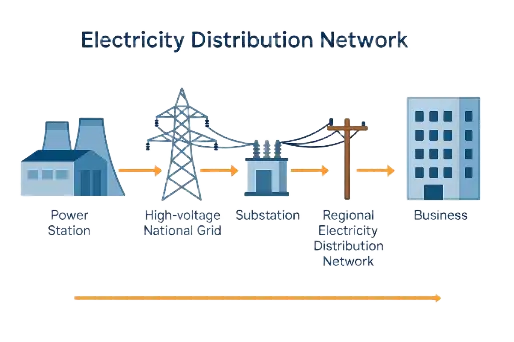
The electricity distribution network is the system of regional cables, substations, and power lines that carries electricity from the National Grid electricity distribution network to local homes and businesses.
Once electricity leaves the high-voltage transmission network, it passes through Distribution Network Operators (DNOs) who manage the lower-voltage infrastructure that powers local properties.
For businesses, understanding how the electricity distribution network works helps explain the costs included in your business energy bills. It also plays a key role in maintaining reliability, responding to power cuts, and connecting new commercial properties to the grid.
What is a Distribution Network Operator (DNO)?
A Distribution Network Operator (DNO) is a regional company licensed to operate, maintain, and upgrade the electricity distribution network within a defined area. Each DNO is responsible for delivering power from the National Grid to homes and businesses in its region, keeping the network safe and reliable.
Across Britain, six main DNO groups are operating a total of fourteen regional networks. Their responsibilities include:
- Managing and maintaining local substations, transformers, and cables
- Restoring power following outages
- Connecting new properties and renewable generation
- Upgrading the network to support future demand
- Supporting new business energy connections
Who is my Distribution Network Operator?
The easiest way to identify the DNO that operates the electricity grid in your area is by using your postcode or a recent electricity bill.
Your DNO is usually listed on an electricity bill sent by your domestic or business energy supplier under “Network Operator” or “Electricity Distributor.”
You can also find your local DNO by entering your postcode on the Energy Networks Association (ENA) website, which shows the company responsible for your region along with its contact details.
Knowing your DNO for your area helps if you need to report a power cut or to check for the latest updates for any ongoing repair work.
List of DNOs
There are six main Distribution Network Operators (DNOs) across Britain. Each is licensed to operate and maintain the electricity distribution network within specific regions.
The table below shows which DNO covers each area, their Distributor IDs, and contact numbers.
| Distribution Network Operator (DNO) | Regions covered | Distributor ID(s) | Contact number |
|---|---|---|---|
| Scottish and Southern Electricity Networks (SSEN) | North Scotland and Central Southern England | 17, 20 | 0800 048 3515 / 0800 048 3516 |
| SP Energy Networks | Central and Southern Scotland, Merseyside, Cheshire, North Wales and North Shropshire | 13, 18 | 0800 092 9290 / 0800 001 5400 |
| Electricity North West | North West England | 16 | 0800 195 4141 |
| Northern Powergrid | North East England and Yorkshire | 15, 23 | 0800 011 3332 |
| UK Power Networks | Eastern England, London and South East England | 10, 12, 19 | 0800 029 4285 |
| National Grid Electricity Distribution | East Midlands, West Midlands, South Wales and South West England | 11, 14, 21, 22 | 0800 096 3080 |
Most of the British DNOs are specialist energy infrastructure firms that manage the grid in more than one region, which is why you may see multiple Distributor IDs linked to the same operator.
The Distributor ID is shown as the first two digits on the bottom line of your MPAN (Meter Point Administration Number) and identifies which DNO supplies your premises.
Independent Distribution Network Operators
In addition to the six main regional DNOs, the electricity network also includes Independent Distribution Network Operators (IDNOs). These companies were introduced to encourage competition and innovation in electricity distribution.
Licensed by Ofgem, IDNOs own and operate local electricity networks that extend DNO infrastructure, often serving new housing developments, industrial estates, or commercial parks.
IDNOs build, operate, and maintain these small local networks once connected, ensuring a safe and reliable electricity supply for all connected properties.
What is an IDNO?
An Independent Distribution Network Operator (IDNO) performs a similar role to a DNO but focuses on smaller, newly built networks. Once an IDNO connects its local system to a DNO’s main network, it becomes responsible for maintaining that infrastructure and supplying electricity to connected premises.
The Independent Distributor ID appears as the first two digits on the bottom line of your MPAN (Meter Point Administration Number). For IDNO networks IDs, please see the list below.
List of IDNOs
Below is the latest UK IDNO list, based on Ofgem’s September 2025 register of licensed Independent Distribution Network Operators:
| Independent Distribution Network Operator (IDNO) | Distributor ID |
|---|---|
| Advanced Electricity Networks Ltd | 42 |
| AGR Networks Ltd | Newly appointed ID pending |
| Aidien Ltd | Newly appointed ID pending |
| Aurora Utilities Ltd | 45 |
| Eclipse Power Networks Ltd | 33 |
| Energy Assets Networks Ltd | 32 |
| ESP Electricity Ltd | 25 |
| Fulcrum Electricity Assets Ltd | 35 |
| Green Generation Energy Networks Cymru Ltd | Newly appointed ID pending |
| Harlaxton Energy Networks Ltd | 29 |
| Independent Distribution Connection Specialists Ltd (IDCS) | 43 |
| Independent Power Networks Ltd | 24 |
| Indigo Power Ltd | 38 |
| Last Mile Electricity Ltd | 26 |
| Leep Electricity Networks Ltd | 30 |
| MUA Electricity Ltd | 34 |
| Optimal Power Networks Ltd | 37 |
| Stark Infra-Electricity Ltd | 39 |
| The Electricity Network Company Ltd | 27 |
| UK Power Distribution Ltd | 31 |
| Utility Assets Ltd | 40 |
| Vattenfall Networks Ltd | 36 |
| Vital Energi Power Networks Ltd | Newly appointed ID pending |
All independent distribution network operators are regulated by Ofgem and must meet the same safety, reliability, and performance standards as regional DNOs.
Why developers and landlords choose IDNOs
Developers, landlords, and commercial site owners often choose independent distribution network operators because they:
- Offer competitive connection and adoption terms compared with regional DNOs.
- Operate nationally, simplifying multi-site or phased projects.
- Provide faster design, approval, and installation services.
- May share future network revenue with developers through adoption payments.
- Often part of multi-utility providers, also acting as an Independent Gas Transporter (IGT) or delivering water, heat, and fibre infrastructure as part of a single connection package.
Who owns the energy grid?
The electricity grid isn’t owned by a single company. Instead, it’s made up of three main parts: transmission, distribution, and supply/meters, each managed by different licensed operators.
Transmission
The transmission network carries electricity at high voltage from power stations and interconnectors across the country.
- In England and Wales, it is owned and maintained by National Grid Electricity Transmission.
- In Scotland, the transmission system is split between SP Transmission (southern Scotland) and Scottish Hydro Electric Transmission (northern Scotland).
These companies maintain the pylons, overhead lines, and substations that move power long distances before it reaches local networks.
The entire high-voltage network is operated by NESO, which is responsible for maintaining the balance of supply and demand across the grid.
Distribution
Once electricity is transmitted to local areas, it’s passed to the distribution network, owned and operated by Distribution Network Operators (DNOs) and Independent Distribution Network Operators (IDNOs).
- The six main DNO groups own 14 regional networks across Great Britain.
- In addition, IDNOs operate smaller, independent networks connected to the main grid.
Together, they deliver electricity to homes and businesses through regional cables and substations.
Meters and supply
The final stage of the energy system involves metering and supply.
- Electricity meters are usually owned or managed by your energy supplier or a specialist meter asset provider.
Suppliers buy electricity on the wholesale energy market and sell it to homes and businesses, billing customers for both the energy used and the network charges paid to the relevant transmission and distribution operators.
How DNOs and IDNOs support businesses
While most businesses deal directly with their business energy supplier, DNOs and IDNOs play a crucial role behind the scenes. They manage, maintain, and upgrade the electricity networks that keep your premises connected and support everything from new installations to resilience planning.
Below are the key areas where DNOs and IDNOs work with businesses:
New connections and upgrades
DNOs and IDNOs handle all new business electricity connections and capacity upgrades to the electricity network. Whether connecting a new site, expanding operations, or installing high-demand equipment, they assess network capacity and ensure safe connection to the grid.
Faults and power cuts
When a fault occurs on the network, your DNO or IDNO is responsible for identifying and repairing it. They manage planned maintenance, emergency repairs, and provide real-time power cut updates to help businesses stay informed.
Priority services
DNOs and IDNOs maintain priority lists for critical infrastructure such as hospitals, emergency services, data centres, and other essential operations. These sites are given enhanced communication and restoration planning during power cuts or network upgrades.
Businesses that rely on continuous power, for example, in manufacturing, healthcare, or logistics, are encouraged to contact their local network operator to discuss resilience measures and contingency planning.
Network resilience and reliability
DNOs and IDNOs strengthen network resilience by investing in infrastructure that can withstand faults, extreme weather, and peaks in demand. They upgrade substations, use automation to detect issues faster, and design networks with backup capacity to keep power flowing.
For businesses, a resilient network reduces downtime and helps maintain continuity during unexpected outages or maintenance.
Outage notifications
DNOs and IDNOs provide advance notice of planned power interruptions, allowing businesses to prepare for temporary downtime. Notifications are available via email, SMS, or web updates.
Export connections
Businesses generating electricity through solar panels, wind turbines, or battery storage need an approved export connection to send surplus power back to the grid.
DNOs and IDNOs assess each site to determine how much energy can be safely exported without overloading the local network. They issue connection agreements, install appropriate metering, and ensure grid stability when generation output fluctuates.
Export connections also enable businesses to use smart export tariffs or Power Purchase Agreements (PPAs), to earn revenue or offset energy costs from their on-site generation.
Flexible services
DNOs and IDNOs run flexible services programmes that help balance electricity demand on local networks. Businesses can sign up to reduce usage, switch to on-site generation, or export stored energy when requested by their network operator.
This is separate from supplier-led demand response schemes; payments and coordination come directly from the DNO or IDNO. By participating, businesses can lower costs and help strengthen local grid capacity.
Data and maps
DNOs and IDNOs publish network data and capacity maps showing existing connections, available capacity, and planned works. These resources help developers, installers, and energy managers plan new projects efficiently.
Electricity network charges on your businesses bill
Your business electricity bill includes several network charges that cover the cost of operating, maintaining, and balancing the energy grid.
These are set by different organisations, including National Grid, your regional Distribution Network Operator (DNO) or Independent Distribution Network Operator (IDNO), and your supplier.
| Charge type | Who sets it | What it covers |
|---|---|---|
| DUoS (Distribution Use of System) | DNO / IDNO | The cost of using the local electricity network that delivers power to your premises, including maintenance and repairs. |
| TNUoS (Transmission Network Use of System) | National Grid Electricity Transmission | The cost of operating and maintaining the high-voltage transmission system that carries power across the country. |
| BSUoS (Balancing Services Use of System) | NESO | Costs of balancing generation and demand in real time to keep the national grid stable. |
| Electricity losses | DNO / IDNO | The small proportion of energy lost as heat while electricity travels through local lines and substations. |
| Connection and upgrade fees | DNO / IDNO | One-off costs for new network connections, capacity upgrades, or service alterations. |
These network-related charges are usually built into your supplier’s pricing and together make up around 20–30% of a typical business electricity bill, depending on your region, voltage level, and business energy consumption.
 Back to blog
- Share: