 Our use of cookies
 New Appointments and Variations (NAVs): How they work in the water market
New Appointments and Variations (NAVs) are companies appointed to build and operate water and sewerage infrastructure for new developments by Ofwat, extending the network of the incumbent water company that services most properties in that area.
This guide explains what NAVs are, how they work and how developers can use them, from Ofwat’s approval through to the water reaching customers’ taps.
Contents:
- What are New Appointments and Variations (NAVs)?
- How does a water NAV work?
- When can Ofwat grant a NAV?
- How do bulk supply and discharge agreements work?
- How do developers apply for a NAV?
What are New Appointments and Variations (NAVs)?
New Appointments and Variations (NAVs) are alternative, independent utility companies granted a licence by the regulator Ofwat to provide water and/or sewerage services to specific areas of England and Wales, in place of the traditional regional monopoly.
Developers often turn to NAVs to build and run the water and sewage services for new residential, commercial and industrial estates, as they are seen as more efficient than the incumbents who would otherwise be the default appointee.
NAVs purchase bulk water and sewerage capacity from the regional water companies that operate the wider network, and deliver these services through their own newly built or refurbished network.
They have the same duties and responsibilities as any water company, are regulated in the same way and must meet the same water quality and environmental standards.
While new appointments are the most common route, NAVs can also be appointed to extend their own network or take over part of another company’s.
Why does NAV exist?
The water industry in England and Wales is built on regional monopolies, so developers and customers normally have no alternative than to arrange new connections with the local water company.
The NAV regime was introduced under the Water Industry Act 1991 to create competition in that closed system (i.e., deregulate the water market), allowing new companies to compete to provide water and/or sewerage services for new or expanding developments.
This puts pressure on incumbents to be more efficient, lowers new water connection costs for the site, and speeds up estate building by delivering water and sewerage connections faster.
How does a water NAV work?
The easiest way to understand a NAV is to follow a new development through the process, from a developer’s initial decision through to customers being billed:
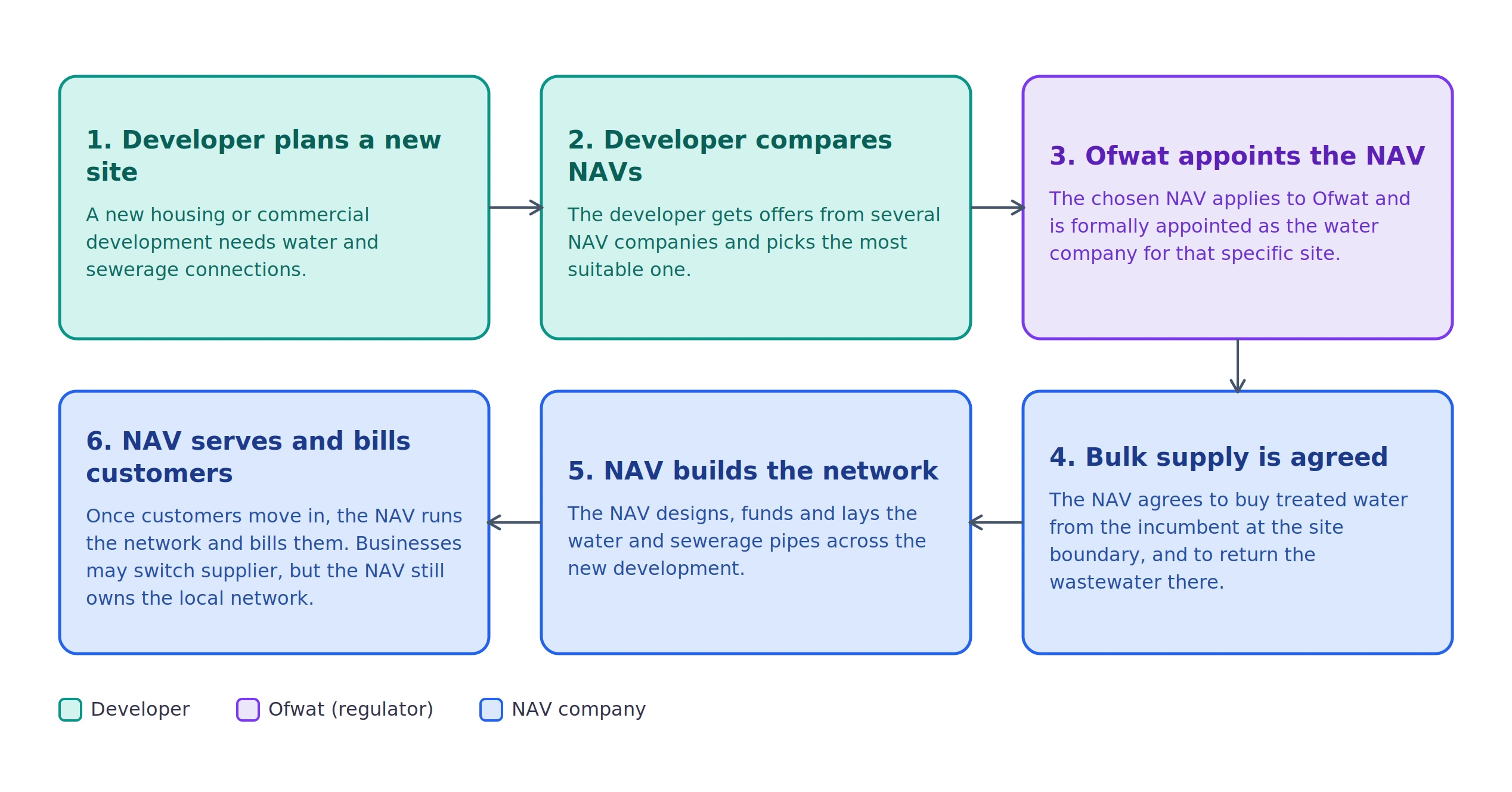
1. The developer chooses a NAV
A developer plans a new housing or commercial site that needs water and sewerage connections.
2. The developer compares NAVs
Rather than defaulting to the regional water company, the developer invites competing NAVs to bid for the water and sewerage services, then compares the offers and chooses the best one.
3. The NAV applies to Ofwat
The chosen NAV applies to Ofwat to be appointed the water supplier for that specific site.
Most applications use the “unserved” criterion, meaning no premises on the site are yet served by an appointed company.
Ofwat checks that the company can finance and run the services, and meet the same standards as any water company, then grants the appointment.
4. The NAV agrees a bulk supply with the incumbent
The NAV does not usually produce its own water or process wastewater. It enters into a bulk supply agreement with the incumbent for these services, buying treated water and returning wastewater to an agreed point on the incumbents existing network.
Ofwat will not finalise the appointment until this agreement is in place.
5. The NAV builds the on-site network
The NAV designs and builds the water and sewerage infrastructure across the site and connects it to the incumbent’s network.
Because the site was previously empty, this is new infrastructure that the NAV owns and operates.
6. The NAV serves and bills the customers
Once residents and businesses move in, the NAV becomes their water company, operating the local network.
The billing arrangements for customers receiving water services by a NAV depend on the type of property:
Households
Households are billed directly by the NAV for their water and sewerage services, and cannot choose a different household supplier. The NAV is their provider for the life of the connection.
Businesses
Each business premises is allocated a Supply Point ID (SPID) for its water connection, which allows it to compare business water suppliers and appoint a retailer of its choice.
Either way, the NAV remains the network owner and operator and only the billing and customer service may change.
What services can a NAV provide?
A NAV provides water and sewerage services to all customers in its assigned area.
This encompasses building and maintaining the infrastructure (pipes, drains, pumps, tanks), and billing and supporting the customers who use them, including:
- Potable water supply: Clean, drinking-quality water piped into the properties.
- Foul water drainage: Wastewater from toilets, sinks, baths, and appliances, taken away for treatment.
- Surface water drainage: Rainwater runoff from roofs, roads, and paved areas, carried off to watercourses or drainage systems.
The NAV can be appointed for the water side, the sewerage side, or both.
When can Ofwat grant a NAV?
Ofwat can only appoint a NAV in place of an incumbent water company when the site meets at least one of three legal criteria set out in the Water Industry Act 1991.
The applicant has to state which one they are relying on:
- Unserved area: The area does not contain any premises already receiving services from an appointed water or sewerage company. This is the route used for new developments on greenfield or cleared land, and it is by far the most common.
- Large user: A customer that uses, or is likely to use, at least 50 megalitres of water a year in England (or 250 megalitres in Wales) at its premises, and wants to switch water companies. This is becoming the common mechanism for water usage at data centres.
- Consent: The existing appointed company agrees to transfer part of its area to another company. This is usually a practical workaround for sites that cannot cleanly qualify as unserved, and in which the incumbent still benefits through wholesale income from selling water and receiving the NAV’s sewerage.
Ofwat assesses water and sewerage separately, so a site may qualify as unserved for one service and get a NAV, but be served for the other in which the incumbent remains.
Also meeting a criterion is necessary but not sufficient, and Ofwat still has to be satisfied that the new company is financially and operationally viable and that customers would be no worse off before it grants the appointment.
How do bulk supply and discharge agreements work?
A NAV typically does not produce its own water or treat its own wastewater, so it must buy both from the incumbent, under bulk supply and discharge agreements.
Here is how the process works, from setting a fair price to measuring the supply and discharge amounts to settle.
1. The NAV and incumbent agree on a bulk price
Before an incumbent can provide its wholesale services to the NAV, the price of the bulk charges needs to be agreed.
These are determined using a “wholesale minus” approach, which works as follows:
Bulk charge = Wholesale price of water and sewerage − Avoided costs due to NAV
- Wholesale price of water and sewerage: The normal wholesale tariff, say £3.20 per cubic metre of water and sewerage combined.
- Avoided costs due to NAV: The costs the incumbent no longer bears because the NAV serves the site itself, such as maintaining the local pipes, say £0.35 per cubic metre.
In this example, the bulk charge would be £2.85 per cubic metre, after subtracting £0.35 from £3.20.
This approach means that domestic and business water rates paid by end-users will not be higher than equivalent properties in the same region.
2. Ofwat can intervene if the incumbent and NAV cannot reach an agreement
Because the NAV depends on the incumbent, the incumbent could in theory set high charges to squeeze out competition.
Ofwat, as the regulator, oversees bulk charges to keep them fair, and if the two sides cannot reach a deal, the NAV can ask Ofwat to determine the terms.
3. The agreement is signed before appointment
The bulk agreement has to be in place before Ofwat finalises the NAV appointment, since without it the NAV has no way to actually supply the site.
4. Water and wastewater flow through bulk meters
Once the NAV’s infrastructure is live, the incumbent delivers treated water to the edge of the site, where it is measured through a bulk meter. The NAV distributes that water across its own local network to the properties.
The sewerage side runs in reverse. The NAV collects wastewater from across the site and hands it back to the incumbent’s network for treatment, measured the same way. These metered volumes are what the bulk charges are applied to.
Who regulates NAV companies?
A NAV is regulated like any other water company, taking on the same duties and oversight as the incumbent it replaces. Four main bodies are involved:
- Ofwat: The economic regulator. It appoints the NAV, sets the rules on charges, and oversees service standards. Licensed NAVs are listed on the Ofwat website.
- The Drinking Water Inspectorate (DWI): Checks that the water supplied is safe to drink and meets quality standards.
- The Environment Agency (EA): The environmental regulator, covering things like how wastewater is discharged. Natural Resources Wales performs this role in Wales.
- The Consumer Council for Water (CCW): Represents customers and handles complaints not resolved by the company. It is a watchdog rather than a regulator.
Sitting above all of them, Defra sets the overall water policy and legislation for England, with the Welsh Government doing so in Wales.
How do developers apply for a NAV?
Developers do not apply to Ofwat directly. The developer chooses a NAV company to serve the site, and that NAV makes the formal application to Ofwat.
The process goes as follows:
- Developer compares and chooses a NAV: The developer approaches several NAV companies for the site and compares them on price, service, and what each will fund or build.
- Developer signs an agreement with the chosen NAV: The developer signs a letter of consent confirming they want that NAV to serve the site, which lets the NAV apply on its behalf.
- Developer hands over the site details: The developer provides what the NAV needs to apply, such as the site layout, the number and type of plots, and the build phasing.
- NAV applies to Ofwat: The NAV submits the application, states the qualifying criterion (usually unserved), provides financial and technical evidence, and agrees bulk supply and discharge terms with the incumbent.
- Ofwat assesses and grants the appointment: The NAV appointment is granted if Ofwat is satisfied with the application.
In practice, there are a small number of established NAVs operators in England and Wales which have a track record of delivering independent water infrastructure to new developments.
New Appointments and Variations (NAVs) FAQs
Our business water experts answer commonly asked questions regarding New Appointments and Variations (NAVs) in England and Wales:
Can a NAV appointment be transferred to another company in the future?
Yes. A NAV appointment can be sold or transferred to another company, but not freely. Ofwat has to be involved and approve the change, since the new owner must meet the same financial and operational standards as the original appointee.
Do NAV customers have different rights from customers of regional water companies?
Not at all. NAV customers get the same core protections and service standards, including water quality oversight from the DWI and complaint handling through the CCW.
Ofwat also applies a “no worse off” principle, meaning NAV customers should not end up paying more than they would under the incumbent.
As with any water company, households cannot switch business water suppliers.
Can a NAV operate across more than one development site?
Yes. A NAV company can hold many separate appointments across many different sites, and even operate in more than one incumbent’s region.
Each site is its own defined area of appointment. This is why a handful of NAV companies between them cover thousands of sites.
Can an existing commercial site switch to a NAV without redevelopment?
It is possible, but uncommon. New-build sites qualify through the unserved route, the most common route, but an existing site would instead need the large-user route, where a big water user wants to switch, or the consent route, where the incumbent agrees to transfer the area.
Can a NAV own only part of a site’s water infrastructure?
A NAV can be appointed for water only, sewerage only, or both, so it may own one network and not the other, for its appointed area.
What happens if a NAV company stops operating?
Customers keep their service. A failed appointee falls under the water industry’s special administration regime, which exists to keep water and sewerage flowing. Ofwat can arrange for the appointment to pass to another company, so supply continues without customers losing service.
Do NAV customers still pay surface water drainage charges?
Yes, customers pay for surface water drainage charges as it works the same as with any other business water supplier.
 Back to blog
- Share: