 Our use of cookies
 What is commercial rainwater harvesting and how it works
Harvesting rainwater for non-potable use is a growing practice, driven by increasingly standardised methods and the steady rise in commercial water rates.
This guide explains how commercial rainwater harvesting works, which properties are most suitable, its benefits and drawbacks, and the main cost factors involved.
Contents:
- What is commercial rainwater harvesting?
- How does rainwater harvesting work for commercial properties?
- Which commercial buildings benefit most from rainwater harvesting?
- Benefits of commercial rainwater harvesting
- Issues with using a rainwater harvesting system
- Commercial rainwater harvesting system costs
What is commercial rainwater harvesting?
Commercial rainwater harvesting is the practice of collecting, storing, and reusing rainwater at businesses, institutions, or other non-residential buildings rather than letting it run off into drains.
Rain that falls on a large roof is funnelled through gutters and downpipes, passed through some basic filtration and sieving to remove leaves and debris, and is held in large tanks or underground cisterns.
From there it’s pumped out and used wherever potable water isn’t required, such as flushing toilets and urinals, irrigating gardens, feeding HVAC systems, and washing vehicles or equipment.
How does rainwater harvesting work for commercial properties?
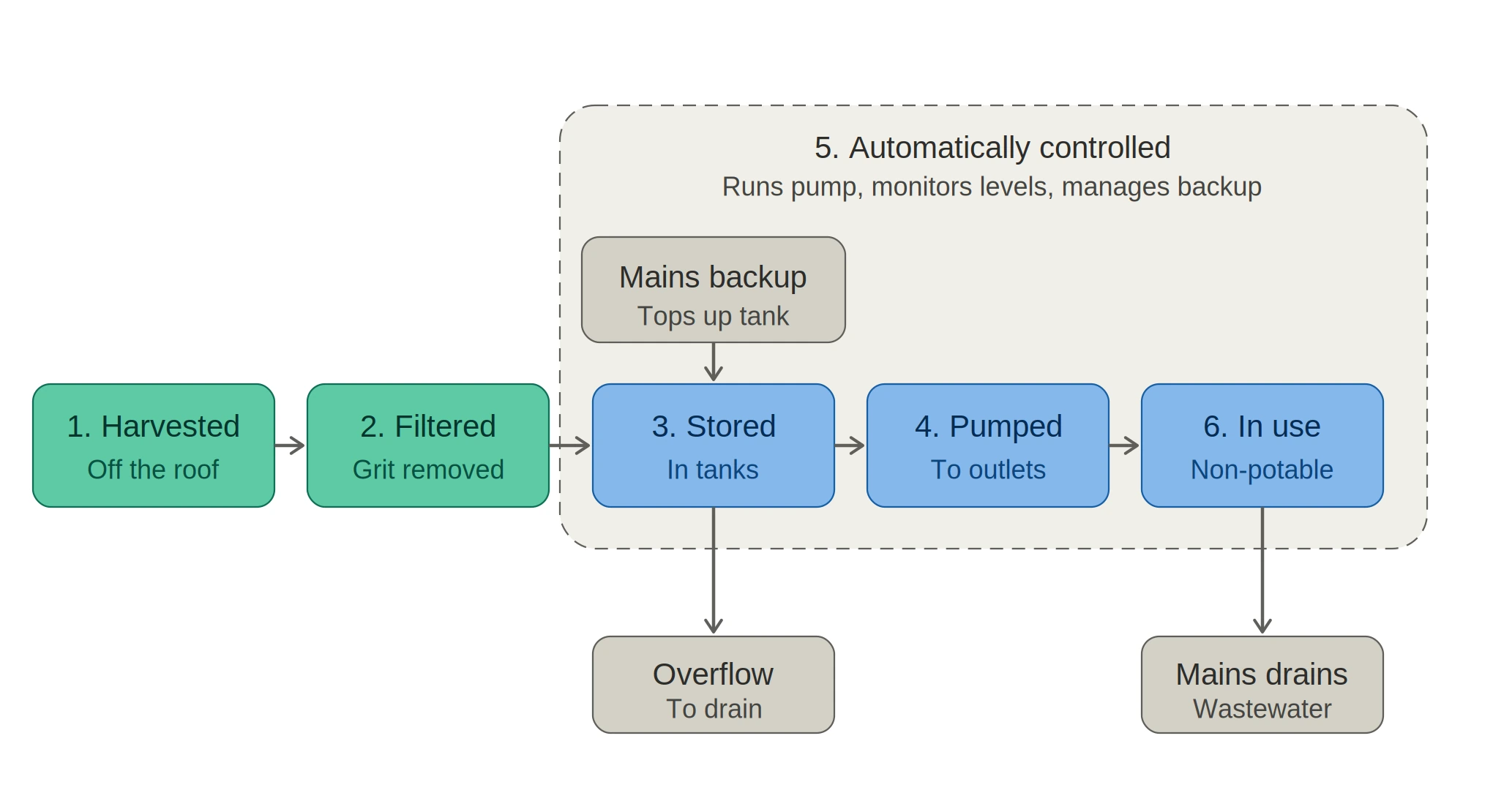
A commercial-scale rainwater harvesting system captures rainwater, treats it, and pumps it to designated outlets around a building. The principles apply to a domestic setup, but the larger volumes and number of outlets require larger tanks and more sophisticated controls.
Here is how it works, step-by-step:
1. Rainwater is harvested
Rainwater is collected off the roof of large commercial properties. These make ideal catchment surfaces because they’re elevated, so water flows away easily, and relatively clean, carrying only dust, leaves, and bird droppings that basic filtration can handle.
How much water is captured depends on:
- Roof area: Every 1 mm of rain on 1 m² of roof area yields about 1 litre, so a bigger roof means more rain collection, which is why large commercial buildings suit harvesting well.
- Rainfall: Local rainfall sets the raw supply, so higher and more consistent rainfall means a fuller tank and less reliance on mains water.
- Roof material and pitch: Smooth surfaces like metal or membrane shed water efficiently and lose very little, while rough or porous roofs absorb some before it reaches the gutter. A steeper pitch drains faster, before water can pool or evaporate.
The water then runs off into the gutters and down through downpipes towards the storage point.
2. Rainwater is filtered
Rainwater off a roof carries leaves, grit, droppings, and dust, so it’s filtered in stages before storage, with each stage catching progressively finer material:
- Coarse leaf guard: A mesh screen at the gutters or downpipes that blocks leaves and large debris. It is simple and cheap, but needs occasional clearing by hand.
- First-flush diverter: Discards the first few litres of each rainfall, which carry the dust and droppings built up during dry weather, then lets clean water through to the tank.
- Self-cleaning filter: The main pre-tank filter. Water runs over an angled mesh; clean water passes to the tank while debris slides off to the drain, so it rarely clogs and needs little maintenance.
Where the water needs to exceed non-potable standards, for example off-grid sites where rainwater and boreholes serve as the mains supply, fine membrane filtration and UV disinfection are added downstream to remove microscopic particles and kill bacteria.
3. Rainwater is stored in tanks or cisterns
Filtered water is held in tanks or underground cisterns until it’s needed. Tanks are typically designed with a calmed inlet, so water enters gently at the base and doesn’t disturb sediment settled at the bottom.
Water is then drawn from just below the surface, which is the cleanest layer. Once the tank is full, an overflow discharges the excess safely to a drain or soakaway.
The tank is sized against expected supply and daily demand, big enough to ride out dry spells but not so large it never fills. The main choice is whether the tank is buried or freestanding:
- Underground storage: Buried in the ground, which requires excavation. It frees up usable space and keeps the water cool and dark, limiting algae growth, though it costs more to install and is harder to access for maintenance.
- Above-ground storage: A freestanding tank that needs no excavation, sited outdoors or in a plant room or basement. It’s cheaper to install and much easier to inspect and maintain, but takes up floor space that could be used otherwise.
4. Rainwater is pumped and fed to outlets
Rainwater runs through its own dedicated pipe network, kept entirely separate from the potable mains and from any greywater system, which prevents cross-connection and keeps each supply clearly identified.
Because the storage tanks sit at or below ground level, a pump is always needed to move water up to the outlets. There are two ways this can be arranged:
- Direct feed: A pump draws straight from the tank and supplies the outlets on demand. It’s the simplest and most common arrangement, but supply stops if the pump or power fails.
- Gravity-fed: Water is pumped up to a header tank at the top of the building, then flows down to the outlets under gravity. The pump only works to fill the header tank, and supply continues briefly even during a power cut, though it needs a high-level tank and the structure to support its weight.
On larger or taller buildings, a direct-feed system simply uses a more powerful pressurised pump set to keep flow and pressure consistent across all floors.
5. The rainwater system is automatically controlled
A control unit manages the whole system automatically, taking on the following functions:
- Runs the pump: Switches the pump on and off in response to demand, and protects it from damage by preventing it from running dry when the tank is low.
- Monitors levels and demand: Uses sensors to track how full the tank is and how much water is being drawn, so supply keeps pace with use.
- Handles the backup water supply: When harvested water runs low, it automatically draws on the mains so the outlets never run dry, then switches back once rain refills the tank.
- Logs usage and flags faults (advanced setups): Records how much water is used and raises an alert for issues like a failed pump, a stuck level sensor, or an unexpected drop in tank level.
6. Harvested rainwater is utilised
Harvested water is delivered to outlets around the building that don’t need drinking-quality water, including:
- Toilets and urinals: Usually the greatest single demand in a commercial building, and the most common reason to harvest.
- Irrigation and landscaping: Watering grounds, planting, and green spaces.
- Wash-down and cleaning: Vehicle washing, yard and floor cleaning, and general outdoor use.
- Cooling and process equipment: Cooling towers, HVAC top-up, and industrial processes that don’t require potable water.
Because these outlets are plumbed only into the rainwater system, any shortfall is topped up at the tank rather than at the outlet, keeping supply steady during dry spells or peak demand.
However, the water used by these systems goes into the same sewage system as with mains water.
Which commercial buildings benefit most from rainwater harvesting?
Although both the supply of rainwater and the demand for non-potable water affect the cost-benefit of a rainwater harvesting system, in practice the size of the roof is the binding constraint, and only large buildings can catch enough rainwater to justify the investment.
Here are some examples:
- Warehouses and distribution centres: Their vast flat roofs are ideal catchment surfaces, collecting large volumes from even modest rainfall. Toilet demand is usually low, so the water is best directed at vehicle washing, yard cleaning, and process use.
- Manufacturing and industrial plants: Large roofs combined with genuine process demand, cooling, wash-down, and equipment cleaning mean both rainwater supply and demand are strong. These sites often use the most harvested water of any building type.
- Schools, colleges, and universities: High occupancy drives heavy toilet and urinal use, and extensive grounds add irrigation demand. Occupancy is predictable too, so supply and demand match well through term time.
- Retail parks and shopping centres: Big roofs over supermarkets and units, plus high footfall through public toilets and large car parks and landscaping to irrigate, make these strong all-round performers.
- Hotels and leisure facilities: Steady, high demand from toilets, laundry, and grounds. Some uses involving human contact need extra treatment, but the sheer volume of non-potable demand still makes a compelling case.
- Sports and recreation grounds: Pitches, greens, and courts need large volumes of irrigation water that never has to be potable, which is close to an ideal use for harvested rain.
In contrast, buildings with small roofs, especially relative to their water use, such as tall multi-storey offices with a modest footprint, capture proportionally less and see slower payback.
Benefits of commercial rainwater harvesting
Rainwater harvesting appeals to commercial operators for a mix of financial, regulatory, and environmental reasons. The main benefits include:
Lower water bills
Using harvested rainwater cuts the amount of mains water a business draws, therefore reducing both the mains water and wastewater charge from the business water bill.
The wastewater charge is estimated as a percentage of the metered mains intake, but since harvested rainwater never passes through the mains water meter, it is also reduced.
As a result, it reduced both charges, even when the amount of wastewater released is the same (i.e., a rainwater toilet still flushed into the same sewage!).
Reduced surface water drainage charges
Most commercial sites pay a separate surface drainage charge based on how much rainwater drains off their property into the public sewer.
By capturing rain that falls on the roof and putting it to use, a harvesting system reduces the volume running into the sewer, which lowers this charge.
Resilience against restrictions
Because the site can draw on its own stored water, harvesting can be a key part of a water contingency plan as it keeps operations running through hosepipe bans and drought restrictions.
This should become increasingly important over time as climate change continues making summers hotter and rainfall more unpredictable.
Meeting planning requirements
New commercial developments increasingly have to manage stormwater on site to gain planning approval.
A rainwater harvesting system stores rainfall and slows its release into the drainage network, helping satisfy these conditions while putting the water to use.
Sustainability credentials
Rainwater harvesting contributes to BREEAM (the Building Research Establishment Environmental Assessment Method, the UK’s main building sustainability standard) and provides a concrete, measurable action for corporate sustainability reporting.
This can improve a property’s value, marketability, and appeal to tenants.
Protection against rising water costs
With water rates trending upward over time, harvesting hedges against future price increases. The longer the system runs, the better the payback becomes.
Issues with using a rainwater harvesting system
Rainwater harvesting is well proven, but like any capital investment it comes with a few real trade-offs. For commercial systems, these come down to cost, the certainty of the return, and water quality:
High upfront installation costs
A commercial system means tanks, pumps, filtration, controls, and a separate pipe network, which together represent a significant capital outlay.
Costs rise further when retrofitting an existing building, since the second pipe network and underground tank are far cheaper to install during construction than to add later.
Ongoing maintenance and compliance
The system needs regular upkeep to keep working efficiently, with filters to clear, pumps and controls to service, and tanks to inspect and desludge periodically.
Commercial systems also have to meet water regulations, including backflow prevention and, in some cases, water-quality checks, which adds a modest administrative overhead. It’s a continuing commitment rather than a heavy one, but it does add to the running cost.
Water quality in storage
Stored rainwater can deteriorate if it sits too long without being used, allowing sediment, bacteria, or stagnation to develop, a particular risk in oversized tanks or during low-use periods such as a school over the summer break.
Good design and maintenance keep this in check through correct tank sizing, a calmed inlet, drawing water from the cleanest layer, and regular servicing, but it’s a factor that needs managing, especially for any use involving human contact.
Commercial rainwater harvesting system costs
Commercial rainwater harvesting system installations run from tens of thousands of pounds for a straightforward site into the hundreds of thousands for a large or complex one.
Whether it is implemented is typically the result of a feasibility study and cost-benefit analysis from a specialist business water supplier, which sizes the system to the site and establishes whether the return justifies the spend.
The main cost factors, ordered by significance, are:
- Storage and groundworks: The tank and the civil works around it are usually the single biggest cost, and the reason underground systems cost more than above-ground ones. Burying a large tank means excavation, groundworks, and craneage, and the bigger the storage, the more of this it takes.
- Distribution pipework: Harvested water needs its own pipe network, separate from the mains, running to every outlet it serves. This is far cheaper in a new build than to retrofit into an existing building, where routing a second network through finished floors and walls adds significant labour and disruption.
- Pumps, filtration and controls: The mechanical and electrical package scales with the volume and pressure the building demands. Costs rise further where the water needs treatment beyond basic filtration, such as UV disinfection for uses involving human contact.
- Design, feasibility and commissioning: Professional fees cover sizing the system to the site, the cost-benefit analysis, and commissioning it to meet Water Regulations. It’s a smaller line than the hardware, but a necessary one.
- Ongoing operating costs: Beyond the upfront outlay, the system carries a running cost, servicing pumps and controls, replacing filters, inspecting and desludging tanks, and the electricity to run the pumps. These are modest against the capital cost, but continuous, and should be factored into any payback calculation.
Commercial rainwater harvesting FAQs
Our business water experts answer commonly asked questions regarding rainwater harvesting systems for business premises:
How much roof space is needed for an effective commercial rainwater harvesting system?
There’s no fixed minimum, but as a rule of thumb, harvesting only stacks up on large roofs, typically from around 500 m² upward, since collection scales directly with roof area.
Ultimately, the minimum viable size depends on local rainfall and how much non-potable water the building uses, which is what a feasibility study establishes.
Do commercial rainwater harvesting systems need planning permission in the UK?
A standalone system usually doesn’t need planning permission, though below-ground tanks and any external structures can, and listed buildings or conservation areas may have added restrictions.
For new developments, it often works the other way round, where managing rainfall on site is increasingly a condition of approval under sustainable drainage (SuDS) rules, so harvesting helps secure permission rather than requiring it.
Can harvested rainwater be used in commercial fire sprinkler systems?
Yes. Sprinkler systems don’t need potable water, and a large stored volume suits them well, so harvested rainwater can feed sprinkler tanks.
It has to be designed in properly, with the storage sized to hold the required firefighting reserve on top of everyday demand, and to meet the relevant fire and water regulations.
How long do commercial rainwater harvesting systems typically last?
The tank is the longest-lived part, often 25 years or more, especially underground concrete or polyethene cisterns.
Mechanical components like pumps, filters, and controls wear faster and are typically replaced or refurbished every 10 to 15 years. With regular maintenance, the system as a whole comfortably outlasts its payback period.
Does harvested rainwater require regular water quality testing?
For standard non-potable uses like toilet flushing and irrigation, routine testing generally isn’t required, though tanks and filters still need regular inspection.
Where the water reaches uses involving human contact, such as showers or spray applications, water quality monitoring becomes important to manage risks like Legionella, and treatment such as UV is added.
Can multiple commercial buildings share one rainwater harvesting system?
Yes, and on campuses, business parks, or retail parks, a shared system can be more cost-effective than separate ones, since a single larger tank and plant serves several buildings.
It needs central storage and a distribution network linking the buildings, so it’s far easier to design into a new development than to retrofit across existing ones.
 Back to blog
- Share: