 Our use of cookies
 Solar water heating for business and industrial use
Solar water heating uses solar energy to heat water for commercial and industrial buildings. Solar-powered water heaters can support high-demand hot water systems to reduce reliance on electricity and gas and lower operating costs.
This guide explains how solar water heating works for businesses, where it is most effective, and typical solar water heating prices.
What is solar water heating?
Solar water heating is a solar technology that uses energy from the sun to heat water for use in commercial and industrial buildings. It is also commonly referred to as solar thermal or a solar-powered water heater, as it focuses specifically on producing hot water rather than generating electricity.
The system works by using solar collectors, usually installed on a roof or open ground, to absorb sunlight. Solar energy heats a transfer fluid inside the collector, which uses a heat exchanger to warm water stored in a cylinder or tank. The heated water can be used directly in certain commercial processes or supplied into an existing hot water system.
Unlike commercial solar panels that generate electricity, solar water heating systems convert sunlight directly into heat. This makes them particularly efficient for sites with regular hot water demand, replacing the need to heat water using gas or electricity.
How solar water heating works
Solar water heating systems use solar collectors to capture heat from sunlight and transfer it into stored hot water. The system operates as two connected circuits: a closed solar heat loop and the building’s hot water system.
The following process describes a typical commercial installation, where solar water heating is used to provide pre-heated water to a central hot water system.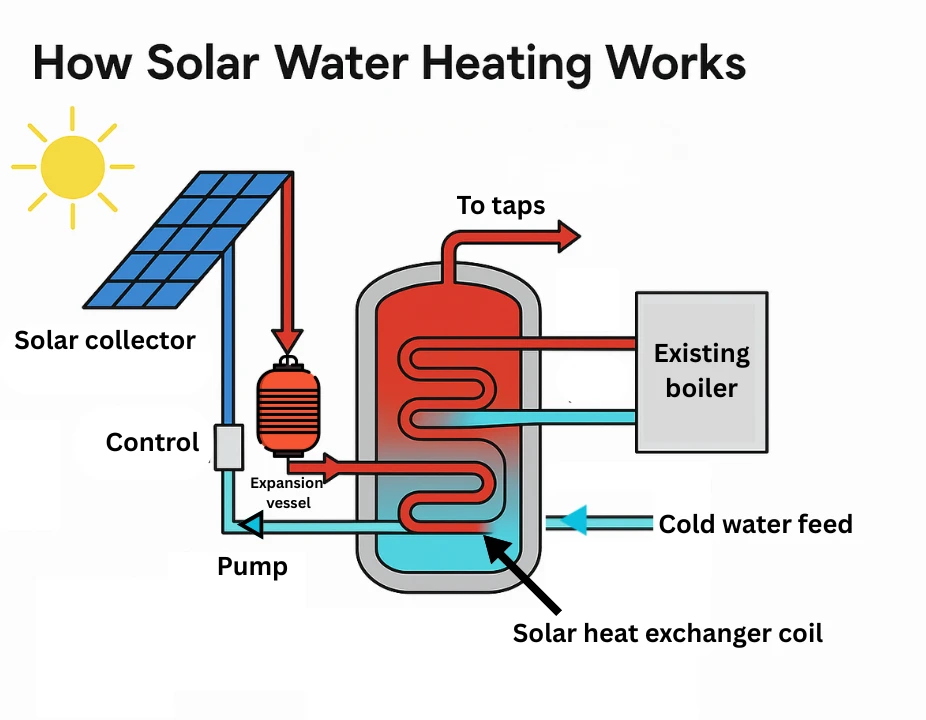
Solar collectors absorb sunlight
Solar collectors are installed on the roof or another suitable location with strong solar exposure. Inside the collector, an absorber surface captures solar radiation and converts it into heat.
This heat does not warm the water directly. Instead, it heats a circulating transfer fluid within the collector.
Heat transfer and circulation
Heat collected by the solar collectors is moved around the system using a closed loop of heat transfer fluid, typically a water and glycol mixture. Glycol is used to protect the system from freezing in cold weather and to maintain stable performance at higher temperatures.
A circulation pump moves this heated fluid between the collectors and the system heat exchanger whenever conditions allow, ensuring heat is captured efficiently without exposing the hot water supply directly to the solar circuit.
Hot water storage
The heated transfer fluid passes through a heat exchanger coil inside a hot water storage tank, where its heat is transferred into the stored water without the fluids mixing.
The storage tank is insulated to retain heat, allowing hot water to be used later even when solar generation does not match demand. This storage capability is essential for balancing daytime solar input with hot water use.
Backup heating and integration with existing systems
To guarantee a reliable hot water supply, solar water heating systems are almost always integrated with a backup heat source. In the UK, this is typically an existing gas boiler system, electric water heater or a heat pump.
Solar water heating is usually installed as a pre-heat stage, where incoming cold mains water is warmed using solar energy before reaching the main boiler or heater. Backup heating only operates when stored water temperatures fall below the required level, topping up heat rather than replacing the solar input entirely.
This approach reduces the amount of gas or electricity required to produce hot water, while allowing the existing system to operate as normal. Because hot water demand varies widely between sites, understanding business water usage is essential when designing and sizing a solar water heating system.
Types of solar water heating systems
Solar water heating systems are typically defined by the type of solar collector they use. The collector is responsible for capturing heat from sunlight and transferring it into the system to heat water.
For commercial and industrial applications, solar water heating systems almost always use either flat plate collectors or evacuated tube collectors, as these are the only technologies proven to deliver reliable hot water at scale.
Flat plate collectors
Flat plate collectors are one of the most widely used solar water heating technologies. They consist of a flat, insulated panel containing a dark absorber plate beneath a transparent cover.
Sunlight passes through the cover, heating the absorber, which then transfers heat into a circulating fluid.
These collectors perform well in moderate conditions and are commonly used in commercial buildings with consistent hot water demand. Their simple, robust design makes them well-suited to large roof areas.
Flat plate collectors are typically chosen where:
- Roof space is available
- Hot water demand is predictable
- Lower upfront system costs are a priority
Evacuated tube collectors
Evacuated tube collectors use a series of individual glass tubes rather than a single flat panel. Each tube contains an absorber surrounded by a vacuum, which significantly reduces heat loss.
This vacuum insulation allows evacuated tube collectors to maintain higher efficiencies, particularly in colder weather or during periods of lower sunlight.
Evacuated tube collectors are commonly selected where:
- Hot water temperatures need to be higher
- Performance is required across all seasons
- Roof space is limited, and efficiency per square metre matters
These systems generally cost more than flat plate collectors and can be more complex to install. However, their improved performance can justify the additional investment for larger or more energy-intensive operations.
How much hot water can solar thermal produce?
The amount of hot water a solar water heating system can produce depends on system size, collector type, location, and how closely hot water demand matches available sunlight.
Solar thermal systems are designed to reduce the energy needed to heat water, rather than meet all hot water requirements on their own.
| Use case | Typical system size | Hot water contribution | What that means in practice |
|---|---|---|---|
| Home | 2 to 4 m² of solar collectors with a domestic hot water cylinder | Around 50 to 70 percent of the annual hot water demand | Most hot water is supplied by solar from spring to autumn, with backup heating used more in winter |
| Small business | 10 to 30 m² of solar collectors with commercial storage | Partial supply of daily hot water demand | Solar preheats incoming water, reducing gas or electricity use during daylight hours |
| Medium to large business | 30 m² plus collector arrays with large thermal storage | Significant daytime hot water contribution | Solar thermal can supply a large share of hot water for kitchens, cleaning, or wash facilities when demand aligns with sunlight |
| Industrial sites | Custom-designed collector fields and thermal storage | Variable and site-specific | Systems are sized around process requirements, reducing boiler load rather than replacing existing systems. |
What affects how much hot water is produced?
Solar water heating output is influenced by:
- Available roof or ground space
- Collector type and efficiency
- Orientation and shading
- Storage capacity
- Seasonal variation in sunlight
- The timing and consistency of hot water use
Because solar output varies throughout the year, most systems are designed to work alongside existing heating infrastructure to ensure consistent water temperatures at all times.
The benefits of solar water heating
Solar water heating offers practical benefits for businesses, particularly where hot water demand is high. While it does not usually replace conventional heating entirely, it can significantly reduce energy use, costs, and environmental impact when used alongside existing systems.
Reduced electricity and gas consumption
Traditional hot water systems rely on a supply of energy from the national grid to operate as follows:
- Gas boiler – Relies on a natural gas supply provided by a business gas supplier.
- Electric heaters and heat pumps – Relies on an electricity supply from a business electricity connection.
Solar water heating works differently. It captures heat directly from the sun and transfers it into hot water, reducing the amount of electricity or gas needed to heat water in the first place. This direct use of solar heat means less dependence on grid supplied energy for everyday hot water demand.
Reduced energy costs
Business electricity prices and commercial gas rates both include a unit cost per kWh of business energy consumption.
The reduction in energy consumption provided by a solar heating system therefore directly reduces business energy bills by offsetting energy that would otherwise be purchased from the grid.
Lower carbon footprint
Grid supplied electricity and gas are still largely generated using fossil fuels and have a significant carbon footprint. Heating water using these fuels contributes directly to a business’s overall emissions profile.
Solar water heating produces hot water without direct emissions at the point of use. By reducing reliance on fossil fuel based electricity and gas, solar thermal can help cut emissions associated with water heating.
For many businesses, solar thermal also supports wider goals around renewable business energy, particularly where hot water demand represents a significant share of overall energy use.
Reliable and proven technology
Solar thermal systems have been used for decades and are a mature, well understood technology. Unlike some newer energy systems, solar water heating relies on simple heat transfer rather than complex electrical components.
This makes systems generally reliable, with predictable performance and relatively low maintenance requirements over their operating life.
Supports existing heating systems
Rather than replacing boilers or water heaters, solar water heating works alongside them. By preheating incoming water, solar thermal reduces the workload placed on existing systems.
This can extend the lifespan of boilers and heaters, reduce wear, and improve overall system efficiency.
Scalable heating system
Solar water heating systems can be scaled to suit different levels of demand. Smaller systems are commonly used in homes, while larger collector arrays and storage tanks are installed at commercial and industrial sites.
This flexibility allows systems to be tailored to actual hot water usage, rather than adopting a one size fits all approach.
Solar water heating systems for businesses
For businesses, solar water heating is less about the technology itself and more about how it is designed into existing hot water systems. Commercial installations focus on reducing fuel use, managing demand, and making the best use of available space and storage.
Centralised hot water systems
Many businesses operate a centralised hot water plant serving multiple outlets across a building or site. Solar water heating is commonly connected to this central heating system, supporting showers, kitchens, washrooms, and radiators from a single thermal store.
By feeding solar-heated water into the plant room, the system reduces the workload placed on boilers or heaters throughout the day, particularly during periods of regular use.
Process and wash water preheating
In industrial and commercial environments, solar water heating is often used to preheat water for industrial processes like wash down systems, food production, and industrial cleaning, where large volumes of warm water are required.
Preheating water before it enters the main heating plant reduces the energy needed to reach operating temperatures, without changing existing processes or controls.
Storage led system design
Unlike domestic systems, business solar water heating relies heavily on thermal storage. Larger hot water cylinders or buffer tanks allow solar heat to be captured when sunlight is available and used later when required.
This storage-led approach is key to making solar thermal effective in commercial environments, as it decouples hot water use from direct sunlight hours.
Example commercial installation
A leisure centre or hotel may use a roof-mounted array of evacuated tube collectors connected to a large thermal store in the plant room. Solar energy is used to preheat water throughout the day, supplying showers, kitchens, and cleaning systems.
When demand exceeds available solar heat, the existing boiler system automatically tops up temperatures. This approach delivers consistent hot water while reducing fuel consumption and overall operating costs.
Solar water heating system components
While the solar water heating process itself is relatively straightforward, overall system performance depends heavily on the quality, sizing, and configuration of individual components. For businesses, component choices affect efficiency, reliability, maintenance requirements, and long-term costs.
The following explains what each component does, why it matters, and the options typically used in commercial installations.
Solar collectors
Solar collectors are the primary heat-generating component of a solar water heating system. Their role is to absorb sunlight and convert it into usable thermal energy.
In commercial systems, the choice between flat plate collectors and evacuated tube collectors affects efficiency, space requirements, and performance across different seasons. Collector selection is usually driven by available roof or ground space, required water temperatures and consumption rates.
Controller unit
The controller unit manages when the system operates. It continuously compares temperatures at the collectors and within the hot water cylinder to determine when heat should be transferred.
More advanced controllers used in commercial systems can also manage backup heating, monitor system performance, and flag faults or temperature issues, helping maintain reliable operation.
Pump station
The pump station circulates the heat transfer fluid around the solar heat circuit. It typically contains the circulation pump, isolation valves, pressure gauges, and safety components within a single sealed unit.
Correct pump sizing is important in larger systems to ensure sufficient flow through the collector array without unnecessary energy use.
Expansion vessel
The expansion vessel manages pressure changes within the solar heat circuit. As the transfer fluid heats up, it expands, and the expansion vessel absorbs this increase in volume.
Inadequate expansion capacity can lead to pressure problems and system stress, making correct vessel sizing particularly important for larger commercial installations.
Hot water cylinder
The hot water cylinder or thermal store holds heated water until it is required. In solar water heating systems, cylinders include a dedicated solar heat exchanger coil connected to the solar circuit.
Commercial systems typically use larger storage volumes to balance solar input with fluctuating demand, allowing heat collected during the day to be used later.
Pipework
Internal pipework connects all components within the system and allows the circulation of both heat transfer fluid and hot water.
In commercial installations, pipework design focuses on durability, pressure tolerance, and minimising heat loss over longer pipe runs.
Insulation
Insulation is critical to system efficiency. High-temperature insulation is used on pipework, cylinders, and key components to retain heat and prevent losses between the collectors and the point of use.
Poor insulation can significantly reduce the effectiveness of an otherwise well-designed solar water heating system.
Solar water heating installation requirements
Installing a solar water heating system requires careful consideration of space, structure, and how the system will integrate with existing hot water infrastructure.
Roof suitability
Solar collectors need a suitable location with good exposure to sunlight. Roofs are the most common installation point, although ground-mounted systems may be used where space allows.
Key considerations include roof orientation, pitch, shading from nearby buildings or trees, and available surface area.
In the UK, south-facing roofs typically provide the best performance, although east or west-facing installations can still be effective.
Structural considerations
Solar water heating collectors add weight to a roof structure. Before installation, the roof must be assessed to ensure it can safely support the additional load, particularly for larger commercial arrays.
In some cases, structural reinforcement may be required. This is more common for older buildings or installations involving extensive collector fields.
Hot water cylinder requirements
Solar water heating systems require a compatible hot water cylinder or thermal store with a dedicated solar heat exchanger coil.
Existing cylinders may need to be replaced if they are not designed for solar input.
Commercial systems often use larger storage tanks to balance solar generation with variable demand, making plant room space an important consideration.
Space requirements
In addition to space for collectors, sufficient room is needed for internal components such as the hot water cylinder, pump station, expansion vessel, and associated pipework.
Domestic systems usually fit within existing airing cupboards or utility spaces, while commercial installations may require dedicated plant rooms or external housing.
Installation timescales
Installation time varies depending on system size and complexity.
- Domestic systems typically take 1 to 3 days to install, including collector mounting and cylinder integration.
- Business systems can take anywhere from several days to a few weeks, depending on collector array size, storage capacity, and integration with the existing hot water plant.
Larger commercial installations may also require additional planning, structural assessments, or phased installation to minimise disruption.
Average prices for solar heating
The cost of a solar water heating system varies depending on system size, collector type, storage requirements, and installation complexity. Domestic systems are typically installed as a retrofit to support existing hot water systems, while commercial installations are custom-designed around usage patterns and available space.
While upfront costs can be significant, solar water heating systems are designed to reduce long-term energy use and costs.
Typical solar water heating costs
| Installation type | Typical system size | Average installed cost | What this usually includes |
|---|---|---|---|
| Domestic | 2 to 4 m² of collectors with solar compatible cylinder | £3,000 to £6,000 | Collectors, cylinder, pump station, controller, pipework, insulation, and installation |
| Small business | 10 to 30 m² of collectors with commercial storage | £8,000 to £20,000 | Collector array, storage tank, controls, integration with existing hot water system |
| Medium to large business | 30 m² plus collector arrays | £20,000 to £60,000+ | Custom system design, large storage, plant room integration, structural work if required |
| Industrial installations | Site specific | Project dependent | Bespoke design based on process water requirements and site constraints |
What affects solar water heating costs?
Solar water heating costs are influenced by:
- Collector type and efficiency
- Available roof or ground space
- Hot water storage capacity
- Structural and access requirements
- Complexity of integration with existing systems
For businesses, system pricing is typically driven by usage patterns rather than floor area, which is why costs can vary significantly between sites.
How much can you save with solar water heating?
Solar water heating reduces the amount of gas or electricity needed to produce hot water by supplying heat directly from the sun. Because hot water demand often runs daily and year round, even a partial solar contribution can significantly reduce overall energy demand.
Rather than replacing existing systems entirely, solar thermal offsets part of the energy required for water heating, lowering ongoing consumption and helping to stabilise operating costs over time.
Typical savings for businesses
In commercial environments, solar water heating can typically reduce the energy required for hot water by around 20 to 40%, depending on system design and usage patterns. Businesses with steady hot water demand during daylight hours tend to see the greatest benefit, as solar heat can be used immediately or stored for short-term use.
Savings are driven less by building size and more by how consistently hot water is used. Where demand is predictable, solar water heating can deliver meaningful reductions in fuel use year after year.
Maintenance and lifespan of solar water heating systems
Solar water heating systems are generally reliable and require less ongoing maintenance than many other energy technologies. However, regular checks are important to ensure safe operation, consistent performance, and long-term system life.
Annual system checks
Most solar water heating systems should be checked once a year. An annual service typically involves inspecting the collectors, pipework, insulation, pump station, and controller settings.
For commercial systems, annual inspections are particularly important due to higher operating temperatures and longer run times. Regular checks help identify pressure issues, sensor faults, or insulation damage before performance is affected.
Glycol replacement
Solar thermal systems usually use a water and glycol mixture as the heat transfer fluid to protect against freezing and overheating. Over time, glycol can degrade and lose its protective properties.
In most systems, glycol replacement is required every 5 to 7 years, depending on operating conditions and system design. Degraded glycol can reduce heat transfer efficiency and increase the risk of corrosion.
Pump lifespan
The circulation pump in a solar water heating system is a mechanical component subject to wear. Under normal operating conditions, pumps typically last 10 to 15 years.
Pump lifespan can be affected by operating temperatures, system pressure, and maintenance quality. Reduced flow rates or unusual noise are common early indicators of pump issues.
Solar collector lifespan
Solar collectors are among the longest-lasting components in the system. Quality flat plate and evacuated tube collectors can operate effectively for 20 to 25 years or more, with minimal performance degradation.
Collectors are designed to withstand weather exposure, although physical damage or seal failure can occur in rare cases.
Signs a system may need attention
Common signs that a solar water heating system may require maintenance include:
- Reduced hot water output compared to previous years
- System pressure warnings or frequent pressure drops
- Unusual pump noise or vibration
- Controller fault alerts or sensor errors
- Visible leaks or damaged insulation
Addressing issues early helps maintain efficiency and prevents more costly repairs later.
 Back to blog
- Share: